

How Do You Mix Home Decor Styles Without It Looking Cluttered?
Last Updated: October 25, 2026
Quick Summary
To mix home decor styles without clutter, pick two styles and let one lead: about 70% primary style and 30% secondary, tied together by a shared throughline such as a color, wood tone, or metal finish. Vary pattern scale, keep the palette tight, and repeat each finish twice.
- Write your style pair down before buying anything, such as modern primary with traditional secondary.
- In a typical living room of ten to twelve pieces, use seven or eight primary and three or four secondary.
- Bedrooms lean toward 80/20 so the primary style stays quieter and the room stays restful.
- Aim for at least three finishes in a room and repeat each one twice.
- Decorate the living room first, because it teaches you your throughline for later rooms.
Table of Contents
- Start With a Design Throughline: Pick Your Primary and Secondary Styles
- The 70/30 Rule in Decorating: How Much of Each Style Should You Use?
- Mixing Modern and Traditional Decor: Where the Two Styles Meet
- How to Mix Patterns in Home Decor Without Overwhelming a Room
- Balance Furniture, Materials, and Color So the Styles Feel Cohesive
- A Room-by-Room Mixing Plan for Real Homes
- Common Mistakes to Avoid When You Mix Home Decor Styles
- Shop by the Person You're Gifting: Curated Pieces That Bridge Styles
- Frequently Asked Questions
Start With a Design Throughline: Pick Your Primary and Secondary Styles
When you mix home decor styles, it starts with one decision: which style leads, and which one follows.
Most rooms that feel cluttered are not crowded. They are confused. Three styles are fighting for attention, and no single one wins.
So pick two styles, not five:
- Primary style: the one that sets the room's mood, roughly 70% of what you see
- Secondary style: the accent layer, roughly 30%, adding contrast and personality
- Design throughline: the one element that repeats across both, such as a color, a wood tone, or a metal finish
Write your pair down before you buy anything. "Modern primary, traditional secondary, warm brass throughline" is a plan. "I like everything" is not.
Architectural Digest guide to mixing design styles makes the same point from the designer side: the strongest mixed rooms always have one dominant voice.
The 70/30 Rule in Decorating: How Much of Each Style Should You Use?
Why those numbers? Because the eye needs a dominant pattern to feel settled.
The rule only becomes useful when you convert it from a feeling into something you can count.
By visual weight. Stand at the room's main entry point and squint.
By piece count. In a typical living room with about ten to twelve meaningful pieces, that means seven or eight primary pieces and three or four secondary ones. A common pattern is:
- Primary (about 70%): sofa, rug, coffee table, main shelving, large art, window treatments, floor lamp
- Secondary (about 30%): accent pillows, a ceramic jar or vase, a patterned frame, a side table in a contrasting finish, hardware
By surface area. Look at the room as flat planes, walls, floor, upholstery, large case goods.
Here is how the split shifts by room type:
- Living room: keep it closest to 70/30, because this is the room guests read first and the mix should be visible.
- Bedroom: lean toward 80/20. The primary style should feel quieter and more dominant so the room stays restful.
- Entry or console: the smallest space can bend toward 60/40, because one bold secondary piece does more work in a tight sightline.
- Dining or mantel: keep 70/30 but shift the secondary weight into texture rather than pattern, so the surface reads rich without busy.
One honest limitation: the rule is a guide, not a law. A small bedroom with one bold secondary piece can bend toward 80/20 and still work. What matters is that one style clearly leads and the other clearly answers it.
The 70/30 split shifts by room type, so here is how each space should lean.
| Room | Split | Note |
|---|---|---|
| Living room | Closest to 70/30 | Room guests read first; mix should be visible |
| Bedroom | Lean toward 80/20 | Primary style quieter and more dominant; room stays restful |
| Entry or console | Bend toward 60/40 | One bold secondary piece does more in a tight sightline |
| Dining or mantel | Keep 70/30 | Shift secondary weight into texture rather than pattern |
Mixing Modern and Traditional Decor: Where the Two Styles Meet
Mixing modern and traditional decor works best when the two styles meet on shared ground: a common color, a common material, or a common shape. Find that meeting point first, then build outward.
Modern brings clean lines, open space, and neutral tones. Traditional brings weight, ornament, and warmth. Put them in the same room and the tension is the point, as long as something connects them.
A few pairings that hold together:
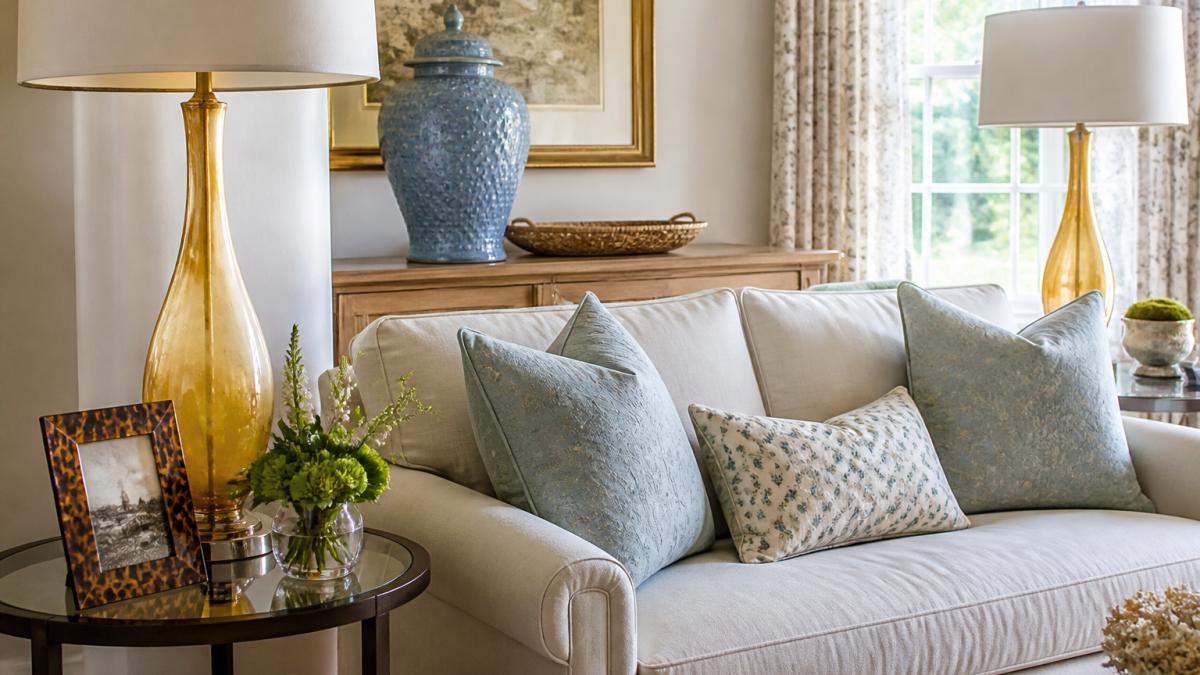
- A classic ceramic silhouette against a clean-lined console. A textured ginger jar gives traditional shape without heavy carving. Our Light Blue Textured Ginger Jar does this well: classic form, soft color, no fuss.
- A traditional frame on a modern acrylic base. The tortoise print in our Tortoise Acrylic Picture Frame reads old-world, but the clear acrylic keeps it light.
- Ornate metalwork on a simple shade. Curved glass bases with plain white drum shades split the difference.
What most guides miss is that the connector matters more than the pieces. Pick the shared element before you shop, or you will buy two beautiful things that ignore each other.


How to Mix Patterns in Home Decor Without Overwhelming a Room
To mix patterns in home decor without overwhelming a room, follow three rules: vary the scale, keep the color palette tight, and give patterns breathing room. Two patterns at the same scale compete. Two patterns sharing a color family cooperate.
The practical version:
- Pick one large-scale pattern as the anchor, such as a rug or a bold print
- Add one small-scale pattern at a distance, like a striped pillow or a fine geometric
- Keep both inside the same two or three colors
- Leave solid space between them, because pattern needs quiet neighbors
A common mistake is treating pattern as a fabric-only decision. Pattern shows up in frames, ceramics, and wood grain too. A tortoise-print frame is a pattern. A textured jar is a pattern. Count those.
If you are pattern-shy, start with one controlled accent and live with it for a week. Our Tortoise Acrylic Picture Frame is a low-risk first step: one pattern, small surface, easy to move.
Balance Furniture, Materials, and Color So the Styles Feel Cohesive
Visual balance is what makes a mixed room feel intentional rather than accidental.
Denim Blue Acrylic Picture Frame →
Start with weight. A heavy, dark traditional dresser needs a light counterpart across the room, or the space feels lopsided.
Then materials. Aim for at least three finishes in a room, and repeat each one twice.
Color does the quiet work.
Lighting belongs here too. Our Curved Gold Glass Table Lamps are transitional by design, which means they sit comfortably between modern and traditional seating instead of picking a side.

Watch out: buying matching sets for everything is the fastest way to erase the mix you worked for. Repeat a finish, not a product.
A Room-by-Room Mixing Plan for Real Homes
A room-by-room plan keeps the 70/30 rule practical, because each room has a different job.
**1.
2. Bedroom, the quiet room. Keep the primary style dominant and calmer, closer to 80/20.
3. Entry or console, the smallest stage. The smallest space gets the boldest secondary piece.
4. Dining or mantel, the texture layer. Layer texture rather than pattern.
**5.
6. Bathroom, the reversible room. Keep the mix light and renter-friendly.
Small-space and rental note: renter-friendly mixing leans on what you can carry out. Lamps, frames, jars, textiles, and removable hardware do the work that paint and built-ins cannot. In a rental, let the fixed finishes set the primary style and use the secondary style entirely in movable pieces, so the mix travels with you.
For a deeper pass on the living room specifically, our guide to styling a cozy living room walks through furniture placement and layering in more detail.
Common Mistakes to Avoid When You Mix Home Decor Styles
The same handful of mistakes sink most mixed rooms. Here are the ones we see most.
- Buying before choosing a throughline. You end up with pieces you love individually and hate together.
- Splitting 50/50 between styles. No dominant voice means no calm.
- Repeating one finish everywhere. Safe, but flat. Aim for three finishes, each repeated twice.
- Matching wood tones too strictly. Slight variation reads collected; exact matching reads catalog.
- Letting pattern pile up at one scale. Vary the scale or skip the second pattern.
- Ignoring scale in small rooms. One oversized piece beats four medium ones.
- Treating the secondary style as an afterthought. The 30% is where personality lives.
If a room feels off and you cannot name why, count your finishes and your patterns. The answer is usually there.
Shop by the Person You're Gifting: Curated Pieces That Bridge Styles
Some of the best decor gifts are the pieces that already bridge two styles, because they fit whatever the recipient's room is doing. That is the logic behind shopping by the person rather than by category.
A few bridges that work for almost any home:
- For the traditional-leaning host: a classic ceramic silhouette in a soft color, elegant enough for a formal dinner table
- For the modern minimalist: a clear acrylic frame with one rich pattern, small enough to disappear into a shelf
- For the new homeowner: a matched pair of lamps, which finishes a room faster than almost anything else
- For the teen or young adult: a self-standing frame that holds photos, tickets, and pressed keepsakes
Our collections group these by recipient, so you can match the person before you match the style. For more ideas, see our best gifts for home decor lovers.
One practical note on timing: if a shower or dinner party is close, order the piece that ships ready to give. Our frames arrive in a color-matched gift box, which removes one errand from your week.
Frequently Asked Questions
What is the 70/30 rule in decorating?
The 70/30 rule in decorating means giving about 70% of a room to your primary style and 30% to a secondary style. The larger share sets the mood and keeps the space from feeling scattered, while the smaller share adds personality and contrast. For example, a room that is 70% traditional might use classic wood furniture and neutral tones, then add 30% modern accents like a sleek lamp or acrylic frame. This proportion helps you mix home decor styles without the result looking like a showroom mishmash.
How do you combine two different home decor styles without clashing?
Start by finding a shared design throughline, such as a common color palette, wood tone, or metal finish. Then apply the 70/30 rule so one style clearly leads. Repeat at least one material or color three times across the room to create visual balance. For instance, if you are mixing modern and traditional decor, choose a neutral sofa as the anchor and repeat a warm wood tone in the coffee table and picture frames. This repetition makes the combination feel intentional rather than accidental.
How many design styles can you mix in one room?
Two styles is the safest number for most rooms, with a third used only in small accents. Three or more styles can work in large, open spaces, but they need a strong shared theme to hold together. A practical approach is to pick a primary style at roughly 70%, a secondary style at 20-30%, and let a third style appear only in accessories like a vase or throw pillow. This keeps the room feeling curated and prevents visual clutter.
How do you mix patterns in home decor without overwhelming the space?
Use a consistent color palette and vary the scale of each pattern. Pair one large-scale print with a medium stripe and a small geometric, and repeat at least one color across all three. Keep the background neutral so the patterns do the talking. A useful guideline is to limit yourself to three patterns per room and give each one room to breathe on separate surfaces. This approach makes pattern mixing feel deliberate and keeps the room from looking busy.
Mixing two styles well takes a plan, and most people stall at the point of choosing pieces that actually connect. We built our collections around exactly that problem: pieces named for the people and moments they celebrate, chosen to sit comfortably beside what you already own. Browse by recipient, start with a single bridging accent, and let the room tell you what it needs next. Get started with Our House of Grace and build a home that feels collected, not cluttered.
