

7 Tips for Styling a Cozy Living Room in 2026
Table of Contents
- Start With a Cozy Living Room Color Scheme
- Layer Soft Textiles: Throws, Pillows, and Rugs
- Living Room Lighting Ideas That Warm the Room
- Living Room Furniture Arrangement for Conversation
- Small Cozy Living Room Ideas That Don't Clutter
- Natural Materials, Greenery, and Personal Touches
- Budget Tiers: Cozy Changes Under $50, $100, and Beyond
- Conclusion
- Frequently Asked Questions
Last Updated: October 20, 2026
Start With a Cozy Living Room Color Scheme
The fastest way to warm a room is to fix the color scheme before buying a single cushion. A cozy living room color scheme leans on warm neutrals for walls and big furniture, then adds one or two accent colors that repeat around the space.
Most rooms feel cold because the base colors are cool. Grey walls, white lights, and black furniture fight each other. Swap one for a warm tone and the room changes.
The 60-30-10 Rule, Applied
This rule keeps a room from feeling random. Split your colors like this:
- 60% base: warm white, cream, oatmeal, or soft greige on walls and the sofa
- 30% secondary: camel, sage, terracotta, or dusty blue on a rug and curtains
- 10% accent: brass, rust, or deep green in pillows, art, and small decor
Pick your 10% accent color first. It is the easiest one to change, and it sets the mood for everything else. For more on how color affects a room, see color theory guidance from the interior design industry.
Layer Soft Textiles: Throws, Pillows, and Rugs
Softness is what people actually feel when they call a room cozy. Layer three textures minimum: something smooth, something nubby, and something plush, a linen sofa, wool rug, and faux fur throw hit all three.
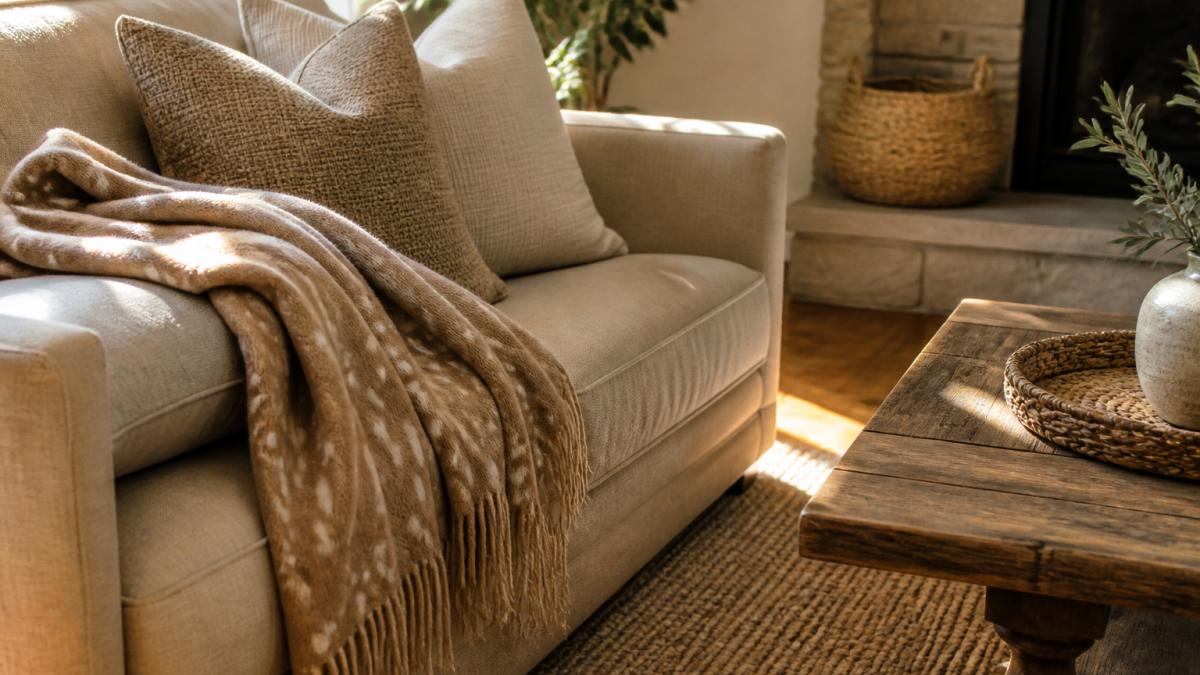
Pillows are the cheapest way to add layers. Use an odd number, mix sizes, and vary the fabric. A 55 cm square behind a 45 cm square looks intentional.
Throws do more work than most people expect. Drape one over a chair arm rather than folding it flat. Our Fawntastic Blanket is a good example: a soft camel and white fawn-spot pattern that reads neutral, so it layers over almost any sofa without clashing.

Getting Rug Size Right
The most common mistake is buying a rug that is too small. A rug should sit under the front legs of every piece of furniture in the conversation area. In a small room, all four legs on the rug works better.
Measure before you buy:
- Sofa length plus 30 to 45 cm on each side
- Front legs of seating on the rug at minimum
- Leave 20 to 30 cm of bare floor around the edges
Living Room Lighting Ideas That Warm the Room
Lighting is the single biggest lever most people ignore. A room with one bright overhead light will never feel cozy, no matter how many blankets you add.
- Ambient: the general light, ideally on a dimmer
- Task: a floor lamp beside a reading chair
- Accent: table lamps, candles, or a small lamp on a console
Warm bulbs matter as much as the fixtures. The U.S. Department of Energy lighting guide explains color temperature in plain terms if you want to check a bulb before buying.
Our Curved Gold Glass Table Lamps, sold as a set of two, are built for this.

Living Room Furniture Arrangement for Conversation
Living room furniture arrangement decides whether people talk or stare at a screen. Pull seating into a U or L shape facing each other, with the sofa and chairs no more than about 2.5 metres apart, beyond that, conversation gets awkward. Below are starting plans for the three most common living room shapes, plus the measurements that keep them working.
Layout Plans by Room Shape
Long, narrow room (often a through-room with a doorway at each end). Do not line everything against the long walls, that creates a bowling alley.
Square room with one focal point (fireplace or large window). Centre the seating on the focal point and build outward in a U shape: sofa facing the focal point, two chairs angled in from the sides, rug anchoring all of it.
Open-plan room with no obvious focal point. Create one.
Doorways, Walkways, and Traffic Flow
Before you move a single piece, map the paths people actually use. The main walkway should be at least 90 cm wide; secondary paths (between sofa and coffee table, for example) can be 45-60 cm. Never place the back of a chair or sofa directly in a doorway sightline, it makes the room feel blocked even if the square footage is fine.
A quick layout check:
| Problem | Fix | Effect |
|---|---|---|
| Seating spread against walls | Pull into a U or L shape | Conversation flows |
| Sofa floats with no anchor | Add a rug and console behind | Zone feels defined |
| Chairs too far from sofa | Close to 2.5 m or less | Easier talking |
| Everything at one height | Mix tall lamp, low table, mid art | Room feels layered |
| Walkway feels tight | Keep 90 cm main path, 45-60 cm secondary | Room feels open |
The 3-5-7 Rule and the 2/3 Rule
Two simple rules handle most styling decisions once the layout is set.
The 3-5-7 rule is about grouping decor. Cluster accessories in odd numbers, three, five, or seven, at varying heights; odd numbers look natural, even numbers look staged.
Heated Faux Fur Throw Blanket — Ivory →
The 2/3 rule is about scale. A rug or sofa should cover roughly two thirds of the seating zone or wall it sits against, leaving the last third open for visual balance.
Small Cozy Living Room Ideas That Don't Clutter
Small cozy living room ideas work on subtraction, not addition. Cozy and cluttered are not the same thing: a small room feels warm with depth and softness, cramped with too many objects.
Start by clearing walking paths. You want at least 45 cm between furniture pieces so people can move without turning sideways. Then use these tricks:
- Hang curtains high and wide to make walls feel taller
- Use a mirror opposite a window to bounce natural light
- Choose furniture with visible legs so floor shows through
Vertical space is your friend. A tall plant, a high shelf, or a floor lamp draws the eye up and makes the ceiling feel further away. For small-space guidance, the home organization resources from the National Association of Professional Organizers cover decluttering in more depth.
Natural Materials, Greenery, and Personal Touches
Natural materials add the texture that makes a room feel lived in. Wood, linen, wool, rattan, clay, and stone all soften a space in a way plastic and lacquer cannot, add at least three natural materials per room. But the right materials change with the season and climate: a room that feels cozy in a cold, dry winter is not the same room that feels cozy in a humid summer.
Seasonal and Climate-Aware Coziness
Cozy is not a fixed set of objects; it is a response to the conditions outside. Adjust these three levers as the seasons change:
- Textiles. In cold months, lean on wool, flannel, faux fur, and heavy knits; in warm, humid months, swap to linen, cotton, and lighter weaves. A wool throw that feels comforting in January feels clammy in July, so keep a storage basket for out-of-season textiles.
- Color. Warm tones (camel, rust, terracotta, deep green) read as cozy in low winter light but heavy in bright summer light. Keep the base neutral year-round and rotate the 10% accent, heavier warm accents in winter, lighter sage or dusty blue in summer.
- Lighting. In winter, layer more warm 2700K lamps and use dimmers to bring light down to eye level after dark. In summer, rely more on natural light and use lamps only for evening ambience. In a very dry climate, a humidifier near a plant grouping makes the air, and the room, feel softer.
Wood, Greenery, and Personal Touches
Wood accents are the easiest entry point: a wood coffee table, rattan basket, or pair of wooden picture frames warms a cool room fast.
Then add personal touches. This is the step that makes a room yours rather than a showroom:
- Framed family photos at eye level
- A stack of books you actually read
- A candle in a scent that means something
Scent belongs in this list. Our Crisp Linen 5.6oz Soy Wax Candle blends cotton blossom with warm sandalwood, and it comes in a printed gift box that suits a hostess gift as well as your own coffee table.
Budget Tiers: Cozy Changes Under $50, $100, and Beyond
You do not need to redecorate to make a room cozy. Most warmth comes from three changes: warmer light, softer textiles, and fewer objects. Here is how to spend at each level.
Under $50
- Swap cool bulbs for 2700K warm ones
- Add a scented candle
- Move a lamp from another room
Around $100
- A soft throw blanket
- Two textured pillow covers
- A dimmer switch for the overhead light
Beyond that
- A properly sized area rug
- A matched pair of table lamps
- A comfortable accent chair
Our own collections sit at the upper end. A heated faux fur throw or a pair of gold glass lamps is meant to last years, not one season.

Conclusion
Most cozy rooms are not expensive rooms. They are rooms with warm light, soft layers, and seating pulled close enough that people actually talk.
If you would rather skip the guesswork, our curated home collections are built around exactly this: warmth, texture, and pieces chosen to be lived with. Browse our throws and blankets, our table lamp sets, and our home fragrance, and pick the one that fits the room you already have.
Frequently Asked Questions
What is the 60-30-10 rule for cozy living room color schemes?
The 60-30-10 rule splits a room's color into three shares. Sixty percent is your dominant tone, usually walls, a large rug, or the sofa. Thirty percent is a secondary color on curtains, an accent chair, or a big throw. Ten percent is the accent you notice first: pillows, a lamp base, art, or a candle label. In a cozy living room, keep the 60 and 30 in warm neutrals like cream, camel, or soft sage, then spend the 10 on something you love. It stops a room from feeling flat without making it busy.
How do I make a small cozy living room feel warm without cluttering it?
Choose fewer, larger pieces instead of many small ones. One 1.5 by 2.1 metre rug reads calmer than three small mats, and a single sofa with two accent chairs beats a cluster of stools. Keep walking paths at least 45 centimetres wide, float furniture slightly off the walls where space allows, and use vertical storage so the floor stays clear. Warmth comes from texture and light, not volume: one soft throw, one table lamp, and a plant will do more than a shelf of small ornaments.
What lighting makes a living room feel cozy?
Layer three sources and keep them low. Overhead light does the cleaning; table and floor lamps do the living. Aim for warm bulbs around 2700K, put lamps at roughly eye level when you are seated, and add a dimmer so evening light can drop without going dark. A pair of table lamps flanking the sofa gives even, flattering light on both ends of the room. Add a candle for scent and a small pool of glow on the coffee table.
How should furniture be arranged to make a living room feel inviting?
Anchor the seating around one focal point, usually the fireplace, a window, or the main wall, and pull chairs close enough that people can talk without raising their voices, roughly 2.5 to 3 metres apart at most. An L-shaped or U-shaped grouping with the sofa facing the focal point and accent chairs at an angle works in most rooms. Leave a clear path behind the sofa if the room is a walk-through, and keep the coffee table about 45 centimetres from the sofa edge so legs have room.
Making a room feel warm takes small, deliberate choices, and it is easier when the pieces already work together. Our House of Grace, LLC curates home and gift collections around warmth and everyday moments, from heated faux fur throws and soft patterned blankets to paired gold glass table lamps and giftable soy candles. Shop by the person you are gifting, or start with one piece for your own living room, and let the room grow from there.